
M5
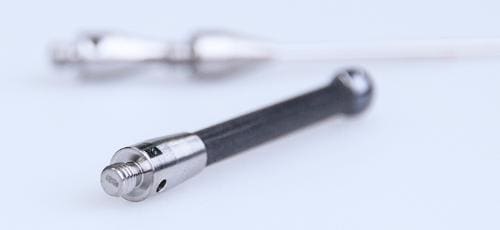
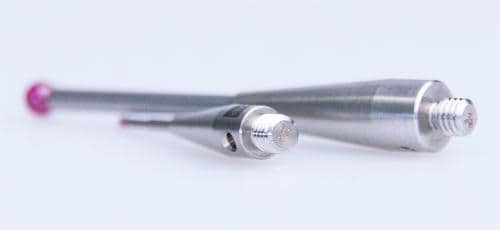
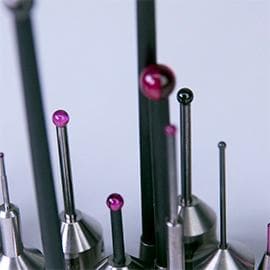
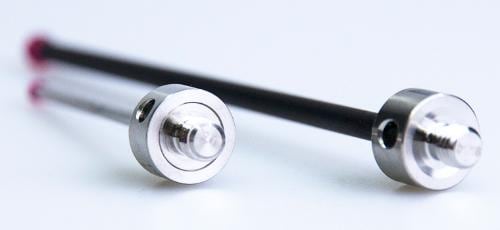
Styli with M5 thread are the ideal choice for the ZEISS VAST probe system.

The stylus is the contact point of the machine with the component to be measured. It deflects the measurement data acquisition in the probe. The size and design of the stylus used is determined by the characteristic to be measured. Key parameters for styli are accuracy, rigidity and service life, which are primarily determined by the materials used and the manufacturing technology.The quality of the stylus is a decisive factor in the quality of the measuring result. The stylus service life is primarily determined by the type of shaft processing and the quality of the connection between the stylus tip and the shaft. High-end production processes and technologies make ZEISS the technology leader in the industry.
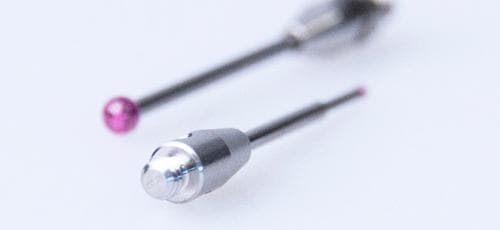
ZEISS styli are available in various versions. A large portfolio of standard styli for M2, M3, M3XXT or M5 threads is available. Different stylus tips made of different materials and different shaft designs can be purchased for these styli. Furthermore, there are also non-threaded styli and special styli for form, contour and surface measurements.
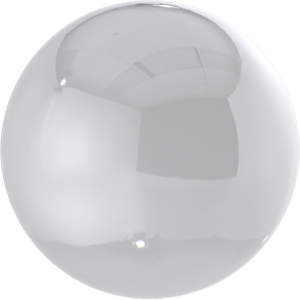
With the hardest material in the world, there is almost no wear and no material buildup during scanning. Diamond spheres are therefore ideal for measuring very hard or highly abrasive workpieces, as well as scanning workpieces where only one point of the sphere is in contact with the workpiece for the most part (e.g. measurements on a rotary table).
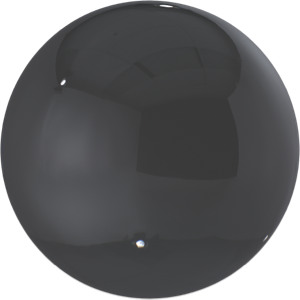
Thanks to coating with the hardest material in the world, there is less wear and material buildup. These styli are particularly suitable for scanning soft materials. They are also ideal for measuring glass and mirror surfaces, as there are virtually no surface defects during scanning.

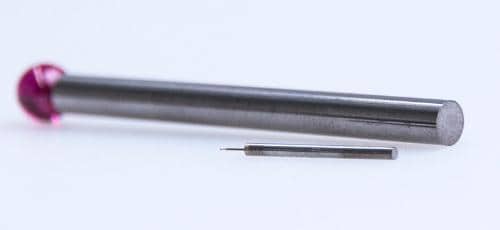
Ruby is the most used sphere material in metrology and is suitable for the most common measurement tasks. Very small spheres from a diameter of 0.12 mm can be produced with ruby.
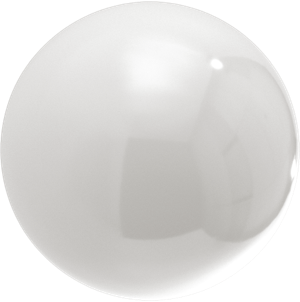
Ceramic spheres have a very low porosity. They are available as high-precision variants, in large sphere diameters and as weight-optimized (hollow) hemispheres and are manufactured according to specifications. They are particularly suitable for scanning rough surfaces such as cast iron.
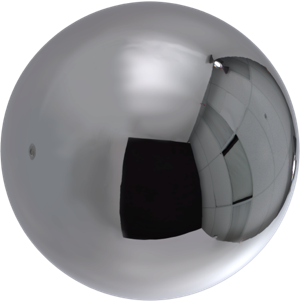
Tungsten carbide spheres can be made to specification. They have a high weight but allow special diameters such as for gear measurement.
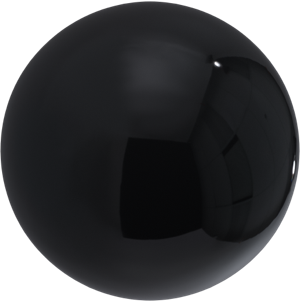
Like ruby, silicon nitride spheres are used for the most common measurement tasks but are particularly suitable for scanning aluminum surfaces.
If a measurement shows strong fluctuations, in 90% of the cases there is a problem with the stylus system. To fix this, you should check the reproducibility of the stylus system and optimize it if necessary.
Other factors can also have an influence on the accuracy of your measurements with styli:
You can check the reproducibility of your stylus system in three steps. Repeat steps 2 and 3 several times and compare the repeatability of the results in an evaluation tool (e.g., Excel or PiWeb):
The standard accuracy of the probe sphere is Grade 5. For form measurements with higher accuracy, spheres with better roundness are needed to minimize errors in the measurement. Note, however, that Grade 3 spheres are not necessarily better than Grade 5 spheres, because the grade of the probe spheres is determined in a batch process. So, if a particular manufacturing batch selection is in tolerance, it is assumed that all spheres are within that grade. The accuracy distribution of the spheres thus corresponds to a Gaussian distribution. That is why poorer spheres accuracies may also be sold in Grade 3.
If you need a styli with very accurate roundness, you should use a styli with a certificate. Only then you can be sure that the specified roundness is maintained and meets your requirements.
A styli, like any other tool, is subject to natural wear and tear. Damage, e.g., by abrasion, scratches or chipping, or contamination, e.g., by material application, oil or paint, significantly affect the measuring accuracy. Since this is usually not visible to the bare eye, the styli should be checked under a microscope for damage or contamination. How often you should perform this inspection depends on the styli's application or the environmental parameters.
We recommend getting an overview by means of a kind of tool card, as it is also available for production machines, and to determine an inspection cycle from it.
How long you can use your styli depends entirely on the type of application. Wearing occurs where the probe sphere touches the workpiece being measured. If the same point is always used, for example when scanning a plane, then the styli will have a shorter life than if circles are scanned, for example. This is because the entire equator of the sphere is in use. Other factors that affect styli life include scanning distance, speed, probing force, measuring environment, and the material being measured.
We recommend that you create a quality card for each styli and use it to test the styli on a regular basis. This will provide a reliable average life of the particular styli over time.
If a collision occurred, the stylus system should be checked on a ring. Since these are high-precision measuring devices, one should not take any risks. Special attention should be paid to styli or extensions with a carbon fiber shaft, as it is possible that individual fibers have been torn. This can only be detected on the ring itself. Styli with a carbide or ceramic shaft can still be used after a collision if the sphere is still on the shaft.
Caution: Extreme care must be taken with dovetailed spheres! In contrast to the case of glued or soldered spheres in a shaft, the spheres do not necessarily fall off in a mortised connection. They can remain loose on the trunnions and lead to measurement errors. Unfortunately, this often happens unnoticed, so you should check dovetailed spheres immediately after a collision.
Shaft touching occurs if there is a contact between the workpiece and the styli shaft instead of the probe sphere. Since the sensor cannot identify if the shaft is contacting the workpiece, shaft touching leads to incorrect measurements that often go unnoticed. When measuring with small probe spheres, which usually have thin shafts, there is a risk that the shaft will blend during probing. If the fasteners, such as angles or cubes, are of poor quality or have been inaccurately adjusted, shaft touching may also occur.
You should pay attention to the following points when planning your stylus system.
The stylus system should
You should also make sure to use high quality components, as the quality of the stylus system pays 100 % into the accuracy of your measurement results.